Role: Business-Process Analyst
|
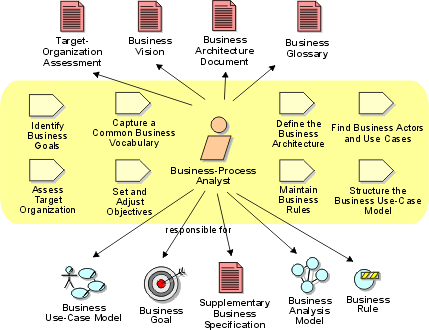
The business-process analyst is responsible for defining the business architecture, and for defining the business use cases and actors, and how they interact. |
|
|
|
Description
The business process analyst leads and coordinates business use-case modeling by outlining and delimiting the organization being modeled—for example, by establishing what business actors and business use cases exist and how they interact. The business-process analyst is responsible for the business architecture, outlining and delimiting the organization being modeled.
He or she is shown below as responsible for Artifact: Business Analysis Model because of this overall architectural responsibility, even though Role: Business Designer creates and maintains it.
Related Information
This section provides links to additional information related to this role.
- Concept: Activity-Based Costing
- Concept: Business Architecture
- Concept: Business Patterns
- Concept: e-business Development
- Concept: Modeling Large Organizations
- Concept: Scope of Business Modeling
Staffing
Skills
A person acting as business-process analyst must be a good facilitator and have excellent communication skills. Knowledge of the business domain is essential for those acting in this role; however, it is not necessary for other roles.
A business-process analyst should be prepared to:
- assess the situation of the target organization where the project's end-product will be deployed
- understand customer and user requirements, their strategies, and their goals
- facilitate modeling of the target organization
- discuss and facilitate a business engineering effort, if needed
- perform a cost/benefit analysis for any suggested changes in the target organization
- discuss and support those who market and sell the end-product of the project
Role assignment approaches
The following are some approaches to assigning this role:
- Assign the Business-Process Analyst and Business Designer roles to the same person. These roles interact a lot, so it can be more efficient to have a single person responsible for both roles.
- Assign the Business-Process Analyst and System Analyst roles to the same person - useful when the business context needs to be understood, but the organization doesn't have existing Business-Process Analyst skills. Many common skills exist between these roles. One concern is that this person may find it difficult to separate business needs from possible solutions, as the System Analyst works with requirements for automated systems.
- Assign the Business-Process Analyst and Test Analyst roles to the same person
- useful where customers are actively involved in the project definition and
ongoing assessment. You might mix this with some more technically skilled
staff assigned solely to the Business-Process Analyst and Test Analyst roles.
Further Reading
See the following Business Modeling references.

|
This content developed or partially developed by Empulsys BV. |
